
Costs
Part of A file sharing service is really selling you its permission model
Seat counts and forgotten retention drive most file sharing pricing
File sharing pricing is set by seat counts, retention you never decided on, and the tier where control appears. Build the five year model yourself.
Storage is the number on the page and almost never the number that decides the bill. It is the meter everyone understands, which is exactly why it is the one used in the headline.
Three things missing from the quote set storage cost over five years.
One is how many people hold an account. The other two are how long you keep things you have stopped using, and what happens at the tier boundary where the control you need finally appears.
What to take away
- Model the account count first. Storage is usually pooled and generous; seats are usually per person and not.
- Everything you never delete is a subscription you renew every month without deciding to.
- The control that makes storage safe often sits a tier above the storage you were quoted.
- Price the exit at the same time as the entry, because the exit is a fixed cost you pay in a bad month.
What the meters actually are
| Meter | What it usually counts | Why the quote can mislead |
|---|---|---|
| Seats | Every account, including ones that belong to systems rather than people | A shared address or an automation account may bill as a person |
| Pooled storage | Total across the organization, sometimes including deleted items still in the recovery window | Per person figures tell you nothing about a heavy user |
| Version history | Either included to a depth, or charged, or trimmed after a period | The depth is the interesting number and is often absent from the table |
| External participants | Sometimes free, sometimes billable once they are named on a space | This is the line that surprises firms with many clients |
| Transfer out | Occasionally metered on the way out only | It only matters once, on the day it is least convenient |
| Retention beyond the default | Almost always a tier feature rather than an add-on | You cannot buy it for the folders that need it and nothing else |
Write your own version of that table with your own numbers in your own units before looking at any offer. Two quotes that look close in the vendor's units routinely stop looking close in yours.
Meters and why quotes mislead
Meter
- Seats
- Accounts, including systems
- Pooled storage
- Org total, deleted included
- Version history
- Included, charged, or trimmed
- External participants
- Free or billable once named
- Transfer out
- Metered on the way out
- Retention beyond default
- Tier feature, not add-on
What it counts
- Seats
- Automation bills as a person
- Pooled storage
- Per-person figures mislead
- Version history
- Depth often absent from table
- External participants
- Surprises firms with many clients
- Transfer out
- Matters on the worst day
- Retention beyond default
- Cannot buy for only some folders
Why it misleads
- Seats
- Pooled storage
- Version history
- External participants
- Transfer out
- Retention beyond default
The count that moves the bill
Seats dominate, and seats grow in ways that budgets do not anticipate. Three drivers do most of it.
Three drivers of seat growth
- Non-human accounts: backup job, scanner, reporting tool
- Read-only people: finance opens three documents a month
- External collaborators: clients become billable when named
- Ask when an outside person becomes billable
- This answer can change the five year figure
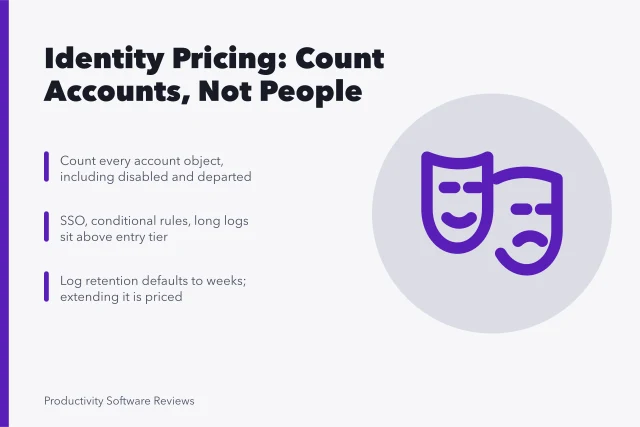
The first is non-human accounts: the backup job, the scanner in the corridor, the reporting tool that reads a folder every night. Each of those may need an identity, and an identity may bill.
The second is people who only read. Somebody in finance who opens three documents a month usually costs the same as the designer who lives in the product all day. Ask early whether a genuinely reduced tier exists, and what it gives up, because the answer is frequently that it exists and cannot see version history.
The third is external collaborators. If your work involves clients, ask precisely when an outside person becomes billable: at first access, on being named to a space, or never. This single answer can change a five year figure by more than the storage line ever will.
Keeping everything is a decision you are already paying for
Most organizations have no deletion policy, which means they have chosen indefinite retention without writing it down. That choice is a recurring cost with no owner.
One afternoon retention questions
- What must be kept and for how long
- What has no obligation attached to it
- Where the second category lives
- Delete the second category once
- Deletion is a process, not an event
Some of it is genuinely required: records rules oblige you to keep certain things for a stated period. The discipline of knowing which is which is the useful half.
The archival principle is that retention should be decided by what a record is, not by how much room is left. The National Archives digital preservation guidance makes this point throughout.
The practical move is not a policy document. It is one afternoon spent answering three questions: what must be kept and for how long, what has no obligation attached to it, and where the second category lives. Deleting the second category once is usually worth more than a year of negotiating on price.
Note also that deletion is a process rather than an event. Content sits in a recovery window, then in backups, then possibly in an archive, and it may bill in all three. The media sanitization guidelines exist because getting rid of data properly is genuinely harder than putting it there, and the same asymmetry shows up on the invoice.
The tier boundary is where the real money is
Storage tends to be cheap and control tends not to be. The features that make a shared estate safe, meaning the access record, the retention rules, the recovery window that is longer than a fortnight, and the ability to stop external sharing by default, are commonly bundled into a higher tier.
Avoid buying control for everyone
Does one requirement force the whole organization up a tier?
Check mixed estate or administration layer
Stay on the storage tier
That produces the most common budgeting mistake in this category: pricing the storage tier, then discovering that one requirement forces the whole organization up a level. The upgrade is rarely available for a subset of people, so a control needed by four people gets bought for four hundred.
Two ways out are worth checking before you accept it. Some products allow a mixed estate, where a smaller group sits on the higher tier and the rest do not. And some requirements can be met elsewhere, for example by an administration layer you already pay for, rather than inside the storage product itself.
Build the five year model
Take a page and fill in your own figures. No product names, no marketing table.
Five year model lines
- Accounts todaypeople, shared, systems
- Expected accounts in year three
- Current data volume and growth rate
- Tier containing every requirement
- External participants and billing
- One-off cost of getting in
- One-off cost of getting out
Lines six and seven are the ones that are usually left blank, and they are the ones that decide whether a small monthly saving is a saving at all. The migration overview is where those numbers come from.
For comparison against neighboring categories, the same modeling discipline applied to office bundles and to collaboration tools will often show that you are paying for the same storage twice, in two products, because each bundle includes some.
Where it fits
None of this decides which product to buy. It decides what the numbers on the table mean. The category overview covers what the products actually differ on, which is a separate question from what they cost.
Common questions
Is unlimited storage real?
The word usually describes an absence of a published cap rather than an absence of a cap. Ask what the fair use position is, what happens when an account is unusually large, and whether the answer is a conversation or an automatic limit. A commitment that cannot be quoted is not a commitment.
Should we pay annually for the discount?
Only once you are past the point where you might leave. An annual commitment taken in month two removes your bargaining position at exactly the moment you are most likely to discover a problem.
Do we need to pay for version history?
You need to know how much you have. Most teams never use more than a few versions back, and the ones who do have a specific reason, usually a document that several people edit under pressure. Find out whether you are that team before paying for depth.
How do we compare a bundled price to a standalone one?
Only by pricing what the bundle replaces at honest figures, and only counting the parts you would otherwise have bought. A bundle that includes storage, mail, and meetings is cheaper than three products only if you actually wanted three products.