Costs
Part of Project management for people who want the details
Best project management software 2027: facts and context, explained properly
The best project management software for 2027 depends on your unit of work, so this ranks named tools by the shape of work they handle best.
No single project management software product is the best for every team in 2027. The ranked shortlist below names the tools buyers keep landing on, ordered by the shape of work each handles best. Pick the row that matches your unit of work, not the row with the longest feature list.
What to take away
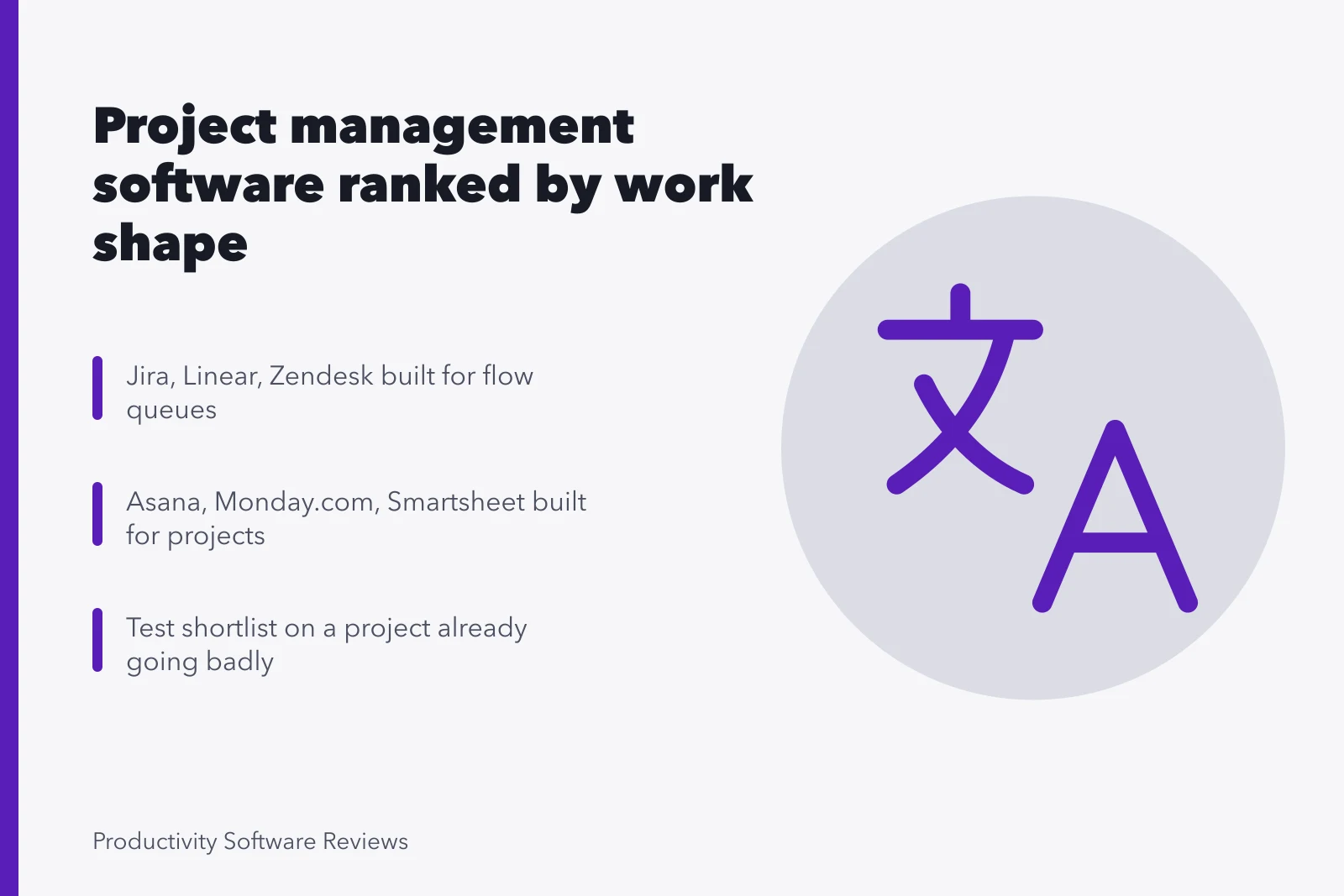
- Jira, Linear and Zendesk are built for flowa queue of items that arrive and get handled.
- Asana, Monday.com and Smartsheet are built for projectsa body of work with an end date.
- Salesforce, HubSpot and Zoho CRM are built for casesa file that stays open and accumulates history.
- Wrike and Planview are built for portfoliosmany projects rolled up and reported together.
- Test any shortlist on a project already going badly, because a clean pilot proves nothing.
| Rank | Tool | Best shape of work | Price signal | Fact to act on |
|---|---|---|---|---|
| 1 | Jira | Flow | Free for up to 10 users; paid plans typically $8 to $16 per user per month | Backlogs, sprints and automation rules for software teams. |
| 2 | Linear | Flow | Free tier; paid plans typically $8 to $14 per user per month | Cycles, issues and roadmaps with keyboard-first speed. |
| 3 | Zendesk | Flow | Support plans typically $55 to $169 per agent per month billed annually | Ticket routing, SLAs and reporting for customer queues. |
| 4 | Asana | Project | Free for small teams; paid plans typically $11 to $25 per user per month billed annually | Tasks live inside projects with owners and due dates. |
| 5 | Monday.com | Project | Paid plans typically $9 to $19 per seat per month billed annually; some tiers require three seats | Boards and automations are configured by the buyer. |
| 6 | Smartsheet | Project | Paid plans typically $9 to $19 per user per month | Grid, Gantt and rollup views over spreadsheet-style work. |
| 7 | Salesforce | Case | Starter around $25 per user per month; higher tiers $100 to $330 per user per month | Cases, accounts and custom objects for long relationships. |
| 8 | HubSpot | Case | Sales Hub Starter typically $20 per seat per month; higher tiers around $100 to $150 per seat per month | Contact and deal records stay open with history. |
| 9 | Zoho CRM | Case | Typically $14 to $52 per user per month | Contacts, deals and cases with workflow rules. |
| 10 | Wrike | Portfolio | Free tier; paid plans typically $10 to $25 per user per month | Cross-project reporting and request forms. |
| 11 | Planview | Portfolio | Quote-based; no published per-seat rate | Portfolio rollups and a shared definition of status. |
Flow tools ranked: Jira, Linear and Zendesk
Jira, from Atlassian, is the default for software teams running sprints and backlogs. It has a free tier for up to 10 users. Paid plans typically run $8 to $16 per user per month and add automation and admin controls. It suits teams that want configurability and can absorb a learning curve.
Linear is the faster, more opinionated alternative for engineering teams that found Jira heavy. It is per-seat, with a free tier and paid plans typically $8 to $14 per user per month. Paid tiers add more history and integrations. It suits product teams that want speed over custom fields.
Zendesk is built for support queues rather than engineering backlogs. It is priced per agent per month, with support plans typically $55 to $169 per agent per month billed annually. Higher tiers add reporting and routing. It suits teams whose work arrives as tickets from customers.
Project tools ranked: Asana, Monday.com and Smartsheet
Asana organizes work as tasks inside projects with owners and due dates. It has a free tier for small teams; paid plans typically run $11 to $25 per user per month billed annually. It suits marketing, operations and cross-functional teams that need a shared view without a steep setup.
Monday.com is built around configurable boards. It charges per seat, with paid plans typically $9 to $19 per seat per month billed annually, and some tiers require three seats. It suits teams that want to shape the tool themselves rather than adopt someone else's workflow.
Smartsheet is a spreadsheet with project features layered on. It is priced per user, with paid plans typically $9 to $19 per user per month. It suits teams already living in spreadsheets who need dependencies and rollups without leaving that mental model.
Case and portfolio tools ranked: Salesforce, HubSpot, Zoho CRM, Wrike and Planview
Salesforce, HubSpot and Zoho CRM all hold a case as a record that stays open for months. The record accumulates notes, documents and one owner. They are priced per seat per month on tiered plans. They suit teams whose work is a long-running relationship rather than a task.
Salesforce starts around $25 per user per month and reaches $100 to $330 on higher tiers. HubSpot Sales Hub Starter is typically $20 per seat per month, with higher tiers around $100 to $150. Zoho CRM typically runs $14 to $52 per user per month.
Wrike handles multiple projects with shared reporting. It is priced per user, with a free tier and paid plans typically $10 to $25 per user per month. It suits organizations running several projects at once that need a rollup view.
Planview is built for portfolio management at enterprise scale. It is priced by quote rather than published per-seat rates. It suits large organizations that report many projects upward on a shared definition of status.
Disqualify before you compare
Four requirements end a candidacy early, and each is a yes or no.
Match tool to shape of work
Flow
- Work item
- Request handled
- Must do well
- Queue, route, spot stuck
- Where it fails
- Non-item deadlines
- Tools
- Jira, Linear, Zendesk
Project
- Work item
- Work with end date
- Must do well
- Sequence, milestones, slippage
- Where it fails
- Many small items
- Tools
- Asana, Monday, Smartsheet
Case
- Work item
- File open months
- Must do well
- History, docs, one owner
- Where it fails
- Cross-case reporting
- Tools
- Salesforce, HubSpot, Zoho
Portfolio
- Work item
- Projects reported together
- Must do well
- Roll up, shared status
- Where it fails
- Detail, flattened
- Tools
- Wrike, Planview
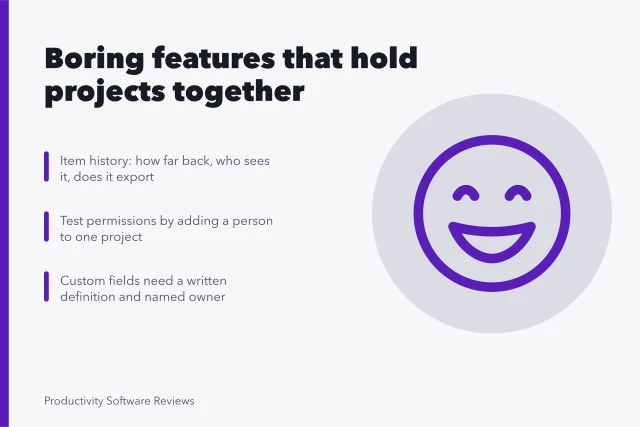
Does the tool hold the shape of work in the table below? Can somebody outside your organization see exactly one project and nothing else? Is there a record of who changed a date and when, on the tier you would buy? Does it export in a form somebody could read without the product?
What a work item is
- Flow: Jira, Linear, Zendesk
- A request that arrives and is handled
- Project: Asana, Monday.com, Smartsheet
- A body of work with an end date
- Case: Salesforce, HubSpot, Zoho CRM
- A file that stays open for months
- Portfolio: Wrike, Planview
- A collection of projects reported together
What the tool must do well
- Flow: Jira, Linear, Zendesk
- Queueing, routing, spotting what is stuck
- Project: Asana, Monday.com, Smartsheet
- Sequencing, milestones, showing slippage
- Case: Salesforce, HubSpot, Zoho CRM
- History, documents, one clear owner
- Portfolio: Wrike, Planview
- Roll up, shared definition of status
Where it fails
- Flow: Jira, Linear, Zendesk
- Anything with a deadline that is not per item
- Project: Asana, Monday.com, Smartsheet
- High volume of small unrelated items
- Case: Salesforce, HubSpot, Zoho CRM
- Reporting across many cases at once
- Portfolio: Wrike, Planview
- Detail, which it flattens by design
Write down the proportion of your work in each row using last quarter, not an intention. A team that is eighty percent flow and buys a planning tool will spend a year fighting it.
The second and third checks are usually answered in the administration layer rather than the product's own settings, so look there before you accept a sales answer.
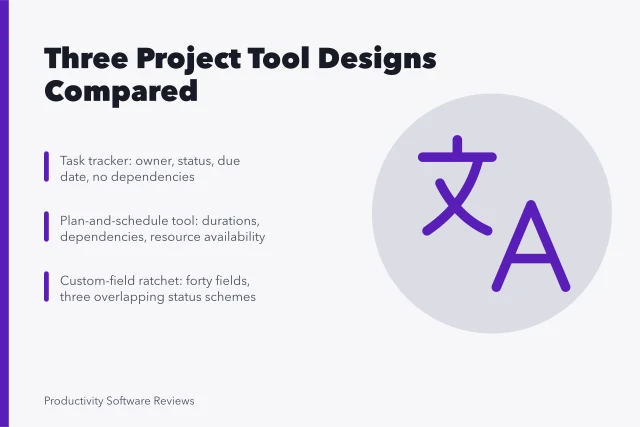
Do not confuse a plan with a schedule
A tool will happily produce a chart with bars on it. Whether that chart means anything depends on properties the tool does not enforce: every activity has a duration, the sequence is complete, the critical path is identifiable, and somebody updates it. The GAO Schedule Assessment Guide sets those properties out in full.
Read it, then decide honestly whether you will maintain that. If the answer is no, do not buy for that capability.
An ordered list with a named owner per item is more truthful than a dependency network that stopped being accurate in March.
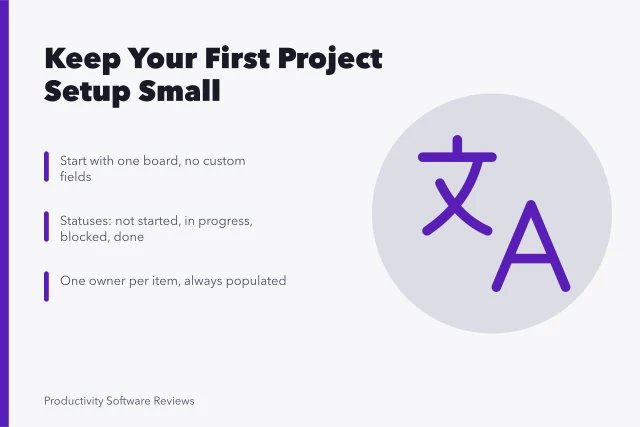
A schedule you will not maintain is a sign the first project management setup should stay deliberately small.
The trial that tells you something
- Pick a project that is currently going badly, or a queue that is overflowing. The tool is being bought for the bad case.
- Move it in as it actually is, including the items nobody wants to own.
- Run it for one full cyclea whole project or a whole month of flow, not a fixed two weeks.
- Have one person log every time somebody asked how to do something, and every time two people used a field differently.
- Halfway through, add an outside collaborator and check exactly what they can see.
- At the end, export everything and open it somewhere the product has never touched.
- Ask the team one questiondid this make the work visible, or did it make reporting easier while the work stayed the same?
Question seven is the whole evaluation compressed. Tools that make reporting easier without making work visible get renewed for years, because the person renewing them is the person who reads the reports.
Seven-step trial that tells you something
- Pick a project going badly or queue overflowing
- Move it in as it actually is
- Run one full cycle, not two weeks
- Log every how-to question and field misuse
- Halfway, add outside collaborator, check visibility
- At end, export and open outside the product
- Askvisible work, or just easier reporting?
Who you are buying from
At some point the product becomes a dependency: your commitments live in it and your history lives in it. That makes the supplier a supplier, with the questions that go with it.
How long have they been running this, what happens to your data if the company is bought, and what notice do you get before a feature you depend on changes. The published supply chain security guidance is a reasonable checklist even for a small purchase, and the questions are easier to ask before you sign.
What the decision usually comes down to
Once disqualifiers are applied, most organizations choose between two products that both work. The decision falls on one of three things. Which one matches the shape of work in the table? Which one is already included in something you pay for? Or which one does the team that will use it most not resent?
What the final choice comes down to
Matches shape of work in table?
pick it
keep looking
The third is not soft. A tool the team quietly refuses to update produces worse information than no tool at all, because the reports look complete.
Where to read next
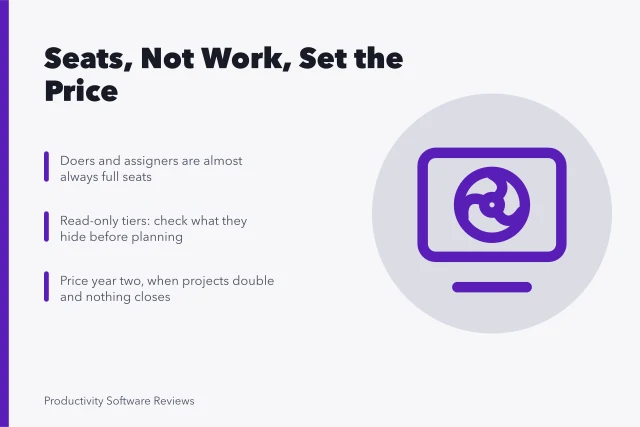
The category overview covers what these products differ on structurally, and the seat counting problem in the neighboring category is the same arithmetic, since both are billed by who holds an account rather than by who does the work.
If the work is really coordination rather than tracking, read the collaboration alternatives first.
And whatever you choose, the setup discipline matters more than the choice.
Common questions
Should we build this in a spreadsheet instead?
For a single team with a single project, a spreadsheet is often better, and honest people admit it. It fails at three things: two people editing at once, history, and any view that spans more than one sheet. When those three start hurting, you have a real requirement rather than a preference.
Can one tool serve both flow work and projects?
Several claim to and a few manage it, usually by being good at one and adequate at the other. Decide which half you are willing to compromise on before the demonstration, because during the demonstration both halves will look fine.
How much should we weigh the opinions of the people who will use it?
Heavily, on usability, and lightly on capability. The team knows whether updating an item is annoying, which decides whether the data is any good. They cannot know whether the reporting will hold up across twelve projects in a year.
Is it worth switching if the current tool mostly works?
Usually not. Migration costs are real, history rarely moves cleanly, and the first six months after a switch are worse than the last six before it. Switch for a requirement you cannot meet, not for a preference you can describe.