Maintenance
Part of Commodity or not: sorting out what still differs in video meetings
Video meeting tools compared by testing the same call four ways
Zoom, Google Meet, Microsoft Teams and Webex run the same recurring call four ways, so the calendar, identity, room and guest seams show up before you buy.
Two video meeting products compared in a demonstration look almost identical, because a demonstration is a well lit room with a good connection and a presenter who has done it four hundred times. Comparison only becomes informative when you hold everything else still and change one thing.
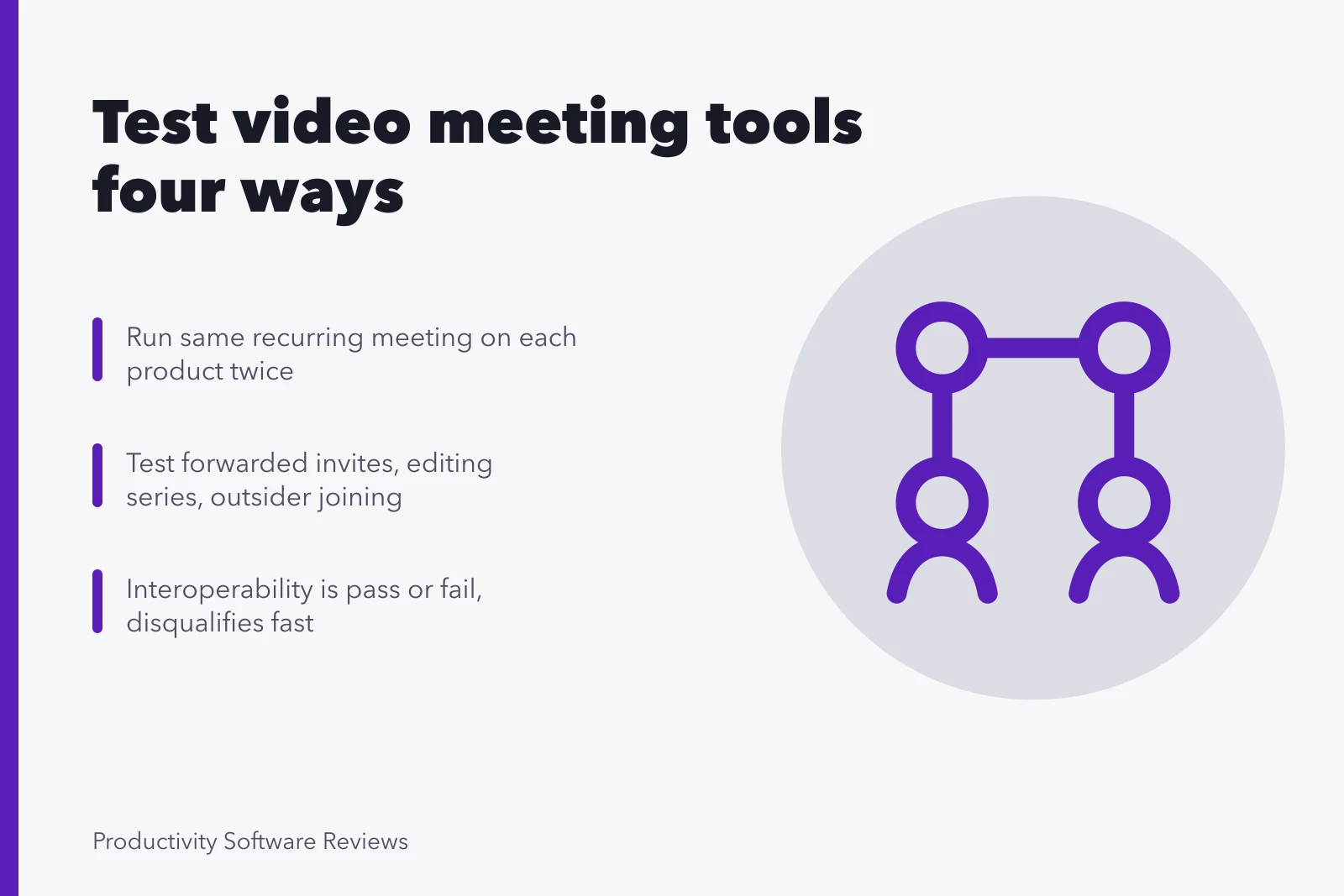
So run the same recurring meeting four ways, on Zoom, Google Meet, Microsoft Teams and Cisco Webex, and watch where each one catches.
What to take away
- Zoom, Google Meet, Microsoft Teams and Cisco Webex all pass a demonstration call. They separate on how a forwarded invitation behaves, how an outsider joins, and whether your existing room hardware connects.
- Entry prices differ in shape. Teams Essentials lists at about $4 per user per month, Google Meet arrives inside Google Workspace tiers, Zoom Pro typically runs $13 to $16 per host per month, and Webex keeps a free tier capped at 50 minutes.
- Run the same real meeting on each product twice. Alternate weeks, same room, same people, including the one who is always on a train.
- Interoperability is a yes or no question, and it disqualifies faster than any feature table.
- Score requirements as pass or fail and preferences separately, then write five sentences on what you gave up.
- A meeting product bundled into a suite you already pay for is close to free. Price that honestly before adding a fifth subscription.
The four products worth testing, named
Zoom sells standalone meetings, webinars and Zoom Rooms, priced per host per month on tiered plans. Its free tier caps group meetings of three or more at 40 minutes, and Zoom Pro typically runs $13 to $16 per host per month. It suits organizations that want one product across desktop, mobile and meeting rooms without buying a whole productivity suite.
Four meeting tools at a glance
Zoom
- Pricing model
- Per host/month
- Typical paid price
- $13-16
- Free tier cap
- 40 min
- Best fit
- Standalone meetings
Google Meet
- Pricing model
- Per user in Workspace
- Typical paid price
- ~$7
- Free tier cap
- 60 min
- Best fit
- Workspace shops
Microsoft Teams
- Pricing model
- Per user in M365
- Typical paid price
- ~$4 Essentials
- Free tier cap
- 60 min
- Best fit
- Exchange/Office shops
Cisco Webex
- Pricing model
- Per user/month
- Typical paid price
- ~$14
- Free tier cap
- 50 min
- Best fit
- Cisco room devices
Google Meet is included with Google Workspace and priced per user per month inside those tiers rather than as a separate line. Business Starter typically sits near $7 per user per month. The consumer version caps group calls at 60 minutes, and the tool adds no new vendor to an organization already running Workspace mail and calendar.
Microsoft Teams is included with Microsoft 365 business plans, priced per user per month. Teams Essentials sells standalone at about $4 per user per month, and the free version caps group meetings at 60 minutes. It suits organizations on Exchange and Office, and it is the hardest one to separate from the rest of the suite when you score it.
Cisco Webex sells per user per month across tiered plans, with a free tier of up to 100 participants for 50 minutes. Paid plans typically start around $14 per host per month. Cisco room devices register to Webex, which makes it the natural test case for the room seam below.
If your shortlist is longer, add one product your largest customer or partner insists on. Their join experience is part of your comparison whether you score it or not.
The four products worth testing
Entry price
- Zoom
- Zoom Pro typically $13 to $16 per host per month billed annually
- Google Meet
- Inside Google Workspace, Business Starter typically around $7 per user per month
- Microsoft Teams
- Teams Essentials about $4 per user per month
- Cisco Webex
- Paid plans typically from about $14 per host per month
Free tier
- Zoom
- 40 minutes, up to 100 participants
- Google Meet
- 60 minutes on group calls, up to 100 participants
- Microsoft Teams
- 60 minutes, up to 100 participants
- Cisco Webex
- 50 minutes, up to 100 participants
Room hardware
- Zoom
- Zoom Rooms license, typically about $49 per room per month, on Windows, Mac and appliance kits from Logitech, Poly and Neat
- Google Meet
- ChromeOS kits from Logitech and Poly, each needing a Meet hardware license
- Microsoft Teams
- Teams Rooms Basic free for up to 25 rooms, Pro at about $40 per room per month
- Cisco Webex
- Cisco Room series endpoints register to Webex, joining other platforms through a gateway
Design the comparison before you run it
Fix four things. The same meeting, meaning a real one with a real outcome. The same participants, including the person who is always on a train. The same physical room, since room acoustics swamp product differences. And the same week, because a network problem on Tuesday is not a product difference.
Fix four things before testing
- Same real meeting with a real outcome
- Same participants, including the train rider
- Same physical room, since acoustics swamp differences
- Same week, so network problems do not skew results
- Alternate products A and B, twice each
- Two people fill the same short form within ten minutes
Then alternate. Run the recurring meeting on product A one week and product B the next, twice each, and have two people fill in the same short form within ten minutes of the end. Ten minutes matters. Impressions decay into preferences quickly.
The four places products actually diverge
The calendar seam. How a meeting gets created is where daily friction lives. Does a forwarded invitation still carry working joining details? Does editing a series break the link? Can an assistant schedule on someone's behalf without swapping accounts? Test by editing a recurring series, which is where several products fail. A Zoom link built from a personal meeting ID survives edits that break a one-off generated link. A Teams invitation forwarded outside your organization often lands the recipient on a sign-in page first.
Where the four products diverge
Calendar seam
- Test
- Edit a recurring series
- Zoom
- PMI link survives edits
- Teams
- Forward lands on sign-in
- Webex
- Series edits vary
Identity seam
- Test
- Admit an outsider
- Zoom
- Account layer decides
- Teams
- Account layer decides
- Webex
- Account layer decides
Room seam
- Test
- Join from owned hardware
- Zoom
- Needs gateway or bridge
- Teams
- Needs gateway or bridge
- Webex
- Cisco kit registers over SIP
The identity seam. Whether people sign in with the account they already have, whether an outsider can be admitted without creating one, and whether an administrator can see and end a session. This is settled in the account layer, not inside the meeting product.
The room seam. Rooms are hardware, and hardware has opinions. Can your existing equipment join meetings hosted by the candidate, and does the answer require replacing anything?
Established room systems often speak older standards rather than a proprietary protocol, and whether a product meets them there is a real dividing line.
A Cisco Room Kit registers to Webex over SIP. Joining a Teams or Zoom meeting from that same kit needs a gateway or a bridge. A Logitech Rally bar certified for Zoom Rooms will not join a Webex meeting without one either.
Public procurement has an established position on this for good reason: the open standards principles exist because interoperability decided later is interoperability bought twice.
The outside seam. Everyone who is not you. How many steps to join, whether an installation is demanded, whether the browser version works, and what happens to a participant whose organization blocks the domain. Test this with an actual outsider, not a colleague on a personal laptop, because a colleague knows what the product is called.
Google Meet and Webex both let a guest join in a browser with no account. Zoom offers browser join too, but pushes the desktop app first. Teams guests typically need the app for audio beyond the basics. Count the clicks yourself rather than trusting the marketing page.
Convert claims into your units
Feature tables in this category are written in vocabularies chosen by the seller. Rewrite them in yours before comparing.
Rewrite vendor claims in your units
What the table says
- Participants
- Supports up to N
- Meetings
- Unlimited meetings
- Recording
- Cloud recording included
- Security
- Enterprise grade
- Devices
- Works on any device
- Calendar
- Integrates with your calendar
- Free plan
- Free plan
- Licensing
- One license per host
What to write down
- Participants
- Our largest meeting M, on this date
- Meetings
- Simultaneous, per account or org
- Recording
- Hours, retention, who deletes
- Security
- Specific settings we enforce, named
- Devices
- Oldest browser and OS supported
- Calendar
- Which calendar, direction, series edits
- Free plan
- Zoom 40, Meet 60, Teams 60, Webex 50
- Licensing
- Hosts counted from last quarter
| What the table says | What to write down instead |
|---|---|
| Supports up to N participants | Our largest real meeting was M, on this date, and it happens X times a year |
| Unlimited meetings | Meetings, or simultaneous meetings, and per account or per organization |
| Cloud recording included | Hours, retention period, and who may delete |
| Enterprise grade security | The specific settings we can enforce, named |
| Works on any device | The oldest browser and operating system still supported |
| Integrates with your calendar | Which calendar, in which direction, and what happens when a series is edited |
| Free plan | What the cap is: Zoom 40 minutes, Meet and Teams 60, Webex 50 |
| One license per host | How many people in our organization host meetings, counted from last quarter's calendar |
The right hand column is answerable. The left hand column is not, and comparing two left hand columns is how organizations end up choosing on price alone.
Devices you do not own
A large share of meeting joins now come from a phone the person owns. That shifts the comparison in two ways: what the product requires installed, and what your organization can require of a device it does not own.
Joining from an unmanaged phone
Zoom
- Install needed
- Own app
- Management profile
- Not required
- Permission prompts
- Phone can refuse
Microsoft Teams
- Install needed
- Own app
- Management profile
- Not required
- Permission prompts
- Phone can refuse
Google Meet
- Install needed
- Browser only
- Management profile
- Not required
- Permission prompts
- Fewer installs to defend
Settle both before a rollout, not during one. The guidance on personal devices at work is a level headed summary of what is reasonable to ask.
In the comparison itself, the test is simple. Join from a personal phone with no management profile installed and see how far you get. Zoom and Teams both run their own app with no profile and ask for permissions the phone can refuse. Meet runs in a browser, which is one fewer install to defend.
Score without fooling yourself
Split the sheet in two and keep the halves apart.
Requirements are pass or fail. Dial in coverage for the countries you work in, support for the room hardware you own, captions, an administrator control you are obliged to have. Very few rows belong here, and any product that fails one is out regardless of how good it feels.
Dial-in is a useful discriminator to run first. Google Meet dial-in arrives through a paid add-on rather than the base plan, and Teams Audio Conferencing is priced separately at about $4 per user per month. Zoom and Webex include dial-in numbers in many countries on paid tiers.
Preferences are traded. Audio quality under load, the number of clicks to share a screen, how chat behaves, whether the recording is usable. Score these individually and compare afterwards, because a group scoring session converges on whoever speaks first.
Then write five sentences on why you chose what you chose, including what you gave up. At renewal, that paragraph is worth more than the whole sheet.
Breaking a tie
If two products both clear the requirements, break the tie in this order.
Breaking a tie between two adequate products
Which product is already paid for in a suite you keep?
choose it, the meeting product is close to free
compare exit: can you take recordings and transcripts out?
What is already paid for, since a meeting product included in a suite you keep anyway is close to free, and the bundle question covers how to price that honestly. Then the exit, meaning which one lets you take recordings and transcripts out in a form you can open elsewhere. Then, and only then, preference.
Spending another month separating two adequate options is a month not spent on a decision where nothing adequate is available.
Where this fits
The category overview sets out what these products differ on structurally. The evaluation protocol is the fuller version of the testing described here, including the join path matrix, and the cost model is where a close comparison usually gets settled.
Common questions
Can we compare fairly without running real meetings?
Not really. Test calls are held by people who are paying attention to the call, which is the opposite of a normal meeting. If you cannot use a real meeting, use a real task: have two people work through a document together while a third joins from a phone outside.
How long should each product get?
Two occurrences of the same recurring meeting, minimum. One is a novelty. Four is better if the meeting is weekly and you can afford the month.
Everyone already prefers the one they used before. Is the comparison pointless?
Familiarity is a real cost and belongs in the score, but it should sit in the preferences column rather than deciding the requirements. Write it down as a line worth some agreed number of points and let it compete with the others.
What if the two products are both fine?
Then you have learned something useful and should stop. Pick the cheaper one to leave, tell people why in one paragraph, and put the time into the parts of the estate where the options are genuinely bad.