Rules
Part of Commodity or not: sorting out what still differs in video meetings
The video meetings features worth paying for leave something behind
Video meetings features worth paying for are the ones that leave something behind: captions, transcripts, and recordings in a format you can still open.
Feature lists in this category are mostly about what happens during the meeting: backgrounds, reactions, hand raising, layouts. Almost none of that changes an outcome.
The features worth paying for are the ones that change what exists after everyone has hung up. A meeting with no residue has to be repeated. A meeting that leaves behind a decision, a record, and a list of who owes what does not.
What to take away
- Judge a feature by what survives the call. Anything that only affects the forty five minutes is a preference.
- Captions and transcripts are two different features with two different jobs, and one of them carries obligations.
- A recording is a file in a format, stored somewhere, for some period. Ask about all three before treating it as a benefit.
- Anything that only works when the meeting is scheduled properly is a habit feature, and habits are the harder half.
Features that leave something behind
What it actually gives you
- Live captions
- Access for anyone who cannot follow audio, and quiet rooms
- Transcript
- A searchable text record of what was said
- Shared meeting notes
- One document everyone edits, attached to the invitation
- Recording
- A replayable copy, for people who could not attend
- Attendance record
- Who joined and for how long
- Chat transcript
- The links and corrections people posted mid meeting
- Follow up items
- A list of commitments with names attached
The question to ask
- Live captions
- Which languages, and how accurate with names and jargon
- Transcript
- Is it stored with the recording, and can it be exported alone
- Shared meeting notes
- Does it survive after the meeting ends, and where does it live
- Recording
- Format, retention, and who may delete it
- Attendance record
- Available to the organizer or only to an administrator
- Chat transcript
- Is it saved with the meeting or lost when it ends
- Follow up items
- Does it write into anything, or is it another place to look
The last row is where most disappointment lives. A meeting product that captures actions and puts them nowhere creates a seventh place to look for work, worse than nothing.
Meeting features and what they leave
Feature
- Live captions
- Access, quiet rooms
- Transcript
- Searchable text record
- Shared notes
- One document everyone edits
- Recording
- Replayable copy
- Attendance record
- Who joined, how long
- Chat transcript
- Links and corrections
- Follow up items
- Commitments with names
What it gives you
- Live captions
- Languages, name accuracy
- Transcript
- Stored, exportable alone
- Shared notes
- Survives, where it lives
- Recording
- Format, retention, deletion
- Attendance record
- Organizer or administrator only
- Chat transcript
- Saved or lost at end
- Follow up items
- Writes into anything or not
Question to ask
- Live captions
- Transcript
- Shared notes
- Recording
- Attendance record
- Chat transcript
- Follow up items
If your work already lives in a tracker, the test is whether commitments can be sent there without retyping. That is a question about the connection layer, not the meeting product.
Captions are not a nicety
Treat live captioning as a requirement rather than a feature to be traded. It serves people with hearing loss, people working in a second language, and everyone in a noisy room, and it costs nothing at the point of use.
Testing caption accuracy
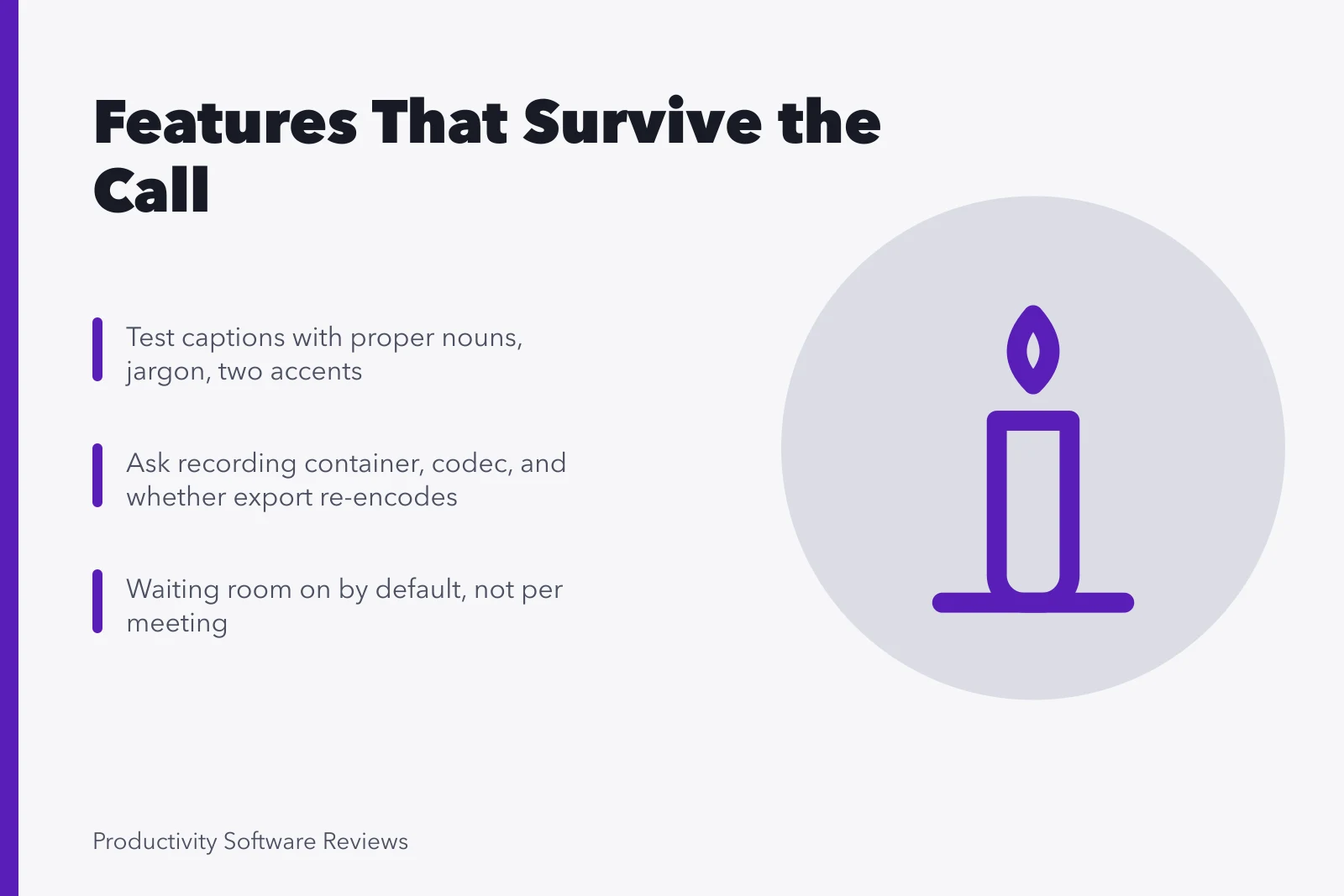
- Run a five minute passage
- Include proper nouns and product jargon
- Include two accents
- Read the caption stream
- Test before it becomes a promise
Accuracy is the thing to test, and to test badly on purpose. Run a five minute passage full of proper nouns, product jargon, and two accents, then read the caption stream. Most engines handle ordinary conversation well and fall apart exactly where your meetings are dense. Test it before it becomes a promise.
Accessibility is a purchasing requirement, not a fix to apply later. The guidance on buying accessible products and services explains why.
Practically, a product without workable captions should fail the requirements column, not lose a few points in preferences.
Recording is three questions, not one
What format does it come out in?
Where does it live and for how long?
Who can delete one?
Control features worth having
These are unglamorous and they are the ones that prevent the incident.
Control features to configure
- Waiting room on by default
- Remove a participant and stop rejoin
- Lock the meeting once all arrive
- Restrict who shares a screen
- Signal clearly when recording starts
That screen limit prevents the most embarrassing failure; the recording signal is a courtesy in some places and a requirement in others.
Configure these before evaluating anything else, because a product that becomes unpleasant once it is configured safely is not a product you can actually run.
Features that are mostly demonstration
Not useless, but rarely decisive: virtual backgrounds, touch up filters, reactions, hand raising in small meetings, whiteboards that nobody opens again, and layout choices. Reactions and hand raising earn their place in genuinely large meetings and nowhere else.
Breakout rooms are the interesting middle case. In training and workshops they are load bearing. In ordinary meetings they are used once, enthusiastically, and never again. Decide which kind of organization you are before paying for a tier that exists to provide them.
The habits underneath the features
Half of what people want from a meeting product is a property of how meetings are run, not of the software. An agenda in the invitation, a named person who writes down the decision, and a rule that a meeting with no decision to make is an email.
None of that ships in any product, and every product is sold as though it might. If your complaint is that meetings are long, unclear, and repeated, the coordination alternatives are a more honest read than any feature comparison.
Where this fits
The category overview covers what these products differ on structurally, and the comparison method turns the features above into a test you can run. If a feature you want sits a tier above the one you were quoted, which happens most often with recording retention and attendance records, the cost model explains how that tends to work.
Common questions
Are automatically generated meeting summaries worth having?
Sometimes, and they need checking. A summary is a claim about what was agreed, and if nobody reads it before it is circulated, an error in it becomes the record. Treat one as a draft written by somebody who was not really listening, which is roughly what it is.
Should we record everything by default?
No. Default recording changes how people speak, produces storage nobody manages, and creates a body of material that can be requested later. Record deliberately, for a reason you could state out loud, and set an expiry.
Do we need a whiteboard feature?
Only if somebody will use it more than twice. The test is whether your in person meetings use a physical whiteboard. If they do not, a virtual one will not be adopted because it is available.
What about attendance tracking for training sessions?
If attendance has to be evidenced, check specifically whether the record is exportable, how long it is kept, and whether it distinguishes joining from being present. A number that counts a person who joined and walked away is not evidence of anything.