Costs
Canadian per-seat software prices compared with US list rates
Productivity software per-seat pricing in Canada: how CAD and USD list rates diverge, exchange-rate effects, support hours, and named vendor rates.
What to take away
- Microsoft 365 Business Basic lists at US$6.00 per seat per month annually, and Microsoft's Canadian rate sits near CAD 8 before tax.
- Google Workspace Business Starter is US$7.20 and about CAD 9.00 in Canada. Business Standard is US$14.40 and about CAD 18.00.
- Slack, Asana and Monday.com publish USD rates and bill most Canadian customers in USD, so the CAD cost is set on the card statement date.
- Microsoft, Google and Zoom publish CAD list rates, which makes a Canadian budget easier to hold.
- Before signing, check billing currency, seat definition, whether the CAD rate resets at renewal, and whether the quote includes GST, HST, PST or QST.
The comparison at a glance
Rates are per user per month on annual commitment unless noted.
Tier
- Microsoft 365
- Business Basic
- Microsoft 365
- Business Standard
- Microsoft 365
- Business Premium
- Google Workspace
- Business Starter
- Google Workspace
- Business Standard
- Slack
- Pro
- Zoom
- Pro
- Asana
- Premium
- Monday.com
- Basic
US list rate
- Microsoft 365
- US$6.00
- Microsoft 365
- US$12.50
- Microsoft 365
- US$22.00
- Google Workspace
- US$7.20
- Google Workspace
- US$14.40
- Slack
- US$7.25, US$8.75 monthly
- Zoom
- US$149.90 per host per year
- Asana
- US$10.99, US$13.49 monthly
- Monday.com
- US$9.00, three-seat minimum
Canadian rate
- Microsoft 365
- about CAD 8
- Microsoft 365
- about CAD 16
- Microsoft 365
- CAD 28 to 31
- Google Workspace
- about CAD 9.00
- Google Workspace
- about CAD 18.00
- Slack
- none published
- Zoom
- CAD 170 to 200 per year
- Asana
- none published
- Monday.com
- none published
Billing currency
- Microsoft 365
- CAD
- Microsoft 365
- CAD
- Microsoft 365
- CAD
- Google Workspace
- CAD
- Google Workspace
- CAD
- Slack
- USD
- Zoom
- CAD on Canadian plans
- Asana
- USD
- Monday.com
- USD
Where the Canadian column gives a range, the spread comes from the vendor's own page pricing monthly and annual commitments differently. It is not a conversion calculated here.
Canadian Per-Seat Pricing by Vendor
Microsoft 365
- Display currency
- CAD
- Billing currency
- CAD
- CAD rate model
- Fixed, reset at renewal
- Support hours
- North American, varies
Google Workspace
- Display currency
- CAD
- Billing currency
- CAD
- CAD rate model
- Fixed on annual plans
- Support hours
- North American, varies
Slack
- Display currency
- USD
- Billing currency
- USD
- CAD rate model
- Converted at card rate
- Support hours
- US hours only
Zoom
- Display currency
- CAD
- Billing currency
- CAD
- CAD rate model
- Fixed on many plans
- Support hours
- North American, varies
Free tiers change the picture. A tool that starts free often moves teams onto paid seats once history and guest access matter, the pattern behind team collaboration pricing.
Example: a 25-seat team at two exchange rates
A 25-seat team on a tool listed at US$12 per seat per month bills US$300 a month. At 1.35 that is 405 CAD. At 1.45 it is 435 CAD, a 30 CAD monthly move, or 360 CAD a year, with nothing changed.
A 2.5 percent card spread lifts those figures to roughly 415 CAD and 446 CAD a month. The same US$12 rate at 40 seats costs 648 CAD a month at 1.35 and 696 CAD at 1.45.
Exchange-Rate Impact on 40 Seats
- 12 USDper seat per month
- 16.20 CADper seat at 1.35
- 17.40 CADper seat at 1.45
- 48 CADmonthly increase
Microsoft 365 Business Standard carries a Canadian list rate near CAD 16 per seat, so 40 seats stay near CAD 640 a month whichever way the dollar moves. The vendor prices that certainty in.
Seat definitions move these figures as much as currency does, and office suites pricing sets out what counts as a user.
Why the CAD rate is not the US rate converted
The spot rate has ranged roughly between 1.35 and 1.45 in recent quarters. Vendors do not reprice daily, and the published CAD rates from Microsoft and Google sit close to a 1.35 conversion.
Three costs fill the gap: tax collection, cross-border payment processing, and serving a market that is small next to US revenue. Fewer Canadian seats also means less room to negotiate custom pricing.
The federal Business and industry - Canada.ca hub covers registration and tax obligations for sellers.
Provincial sales tax adds a layer. British Columbia, Saskatchewan and Manitoba run their own regimes, and the BC small business page sets out what registration means for a seller based there.
Who absorbs the currency risk
Three billing models decide that.
- A fixed CAD list rate published on the pricing page and locked for the term. Microsoft 365 and Google Workspace use this model.
- Conversion at the vendor's own scheduled rate, refreshed quarterly or annually. The buyer carries the movement between resets.
- Invoice in USD at the card network's rate on the statement date. Slack and Monday.com bill this way. Canadian issuers typically add 2 to 3 percent on USD transactions, the same card cost that sits under business email pricing.
The third model is the hardest to forecast across 12 months. Ask for a CAD contract fixed for 12 months and a cap on renewal increases.
Budget a 10 percent cushion on USD-billed software: US$200 on a US$2,000 monthly stack, about CAD 280 at 1.40.
Taxes, residency and support hours
Canadian list prices are quoted before tax in almost every case. A vendor registered for GST or HST adds the applicable rate at checkout, and Quebec adds QST. Registration status decides whether the vendor charges you or you account for the tax yourself. The CRA's tax services hub covers the filing side.
Billing currency, tax registration and data residency are separate questions. A vendor can invoice in CAD and still store data in the United States. Teams that record meetings should read AI meeting notes for Canadian companies before treating a CAD invoice as a privacy answer.
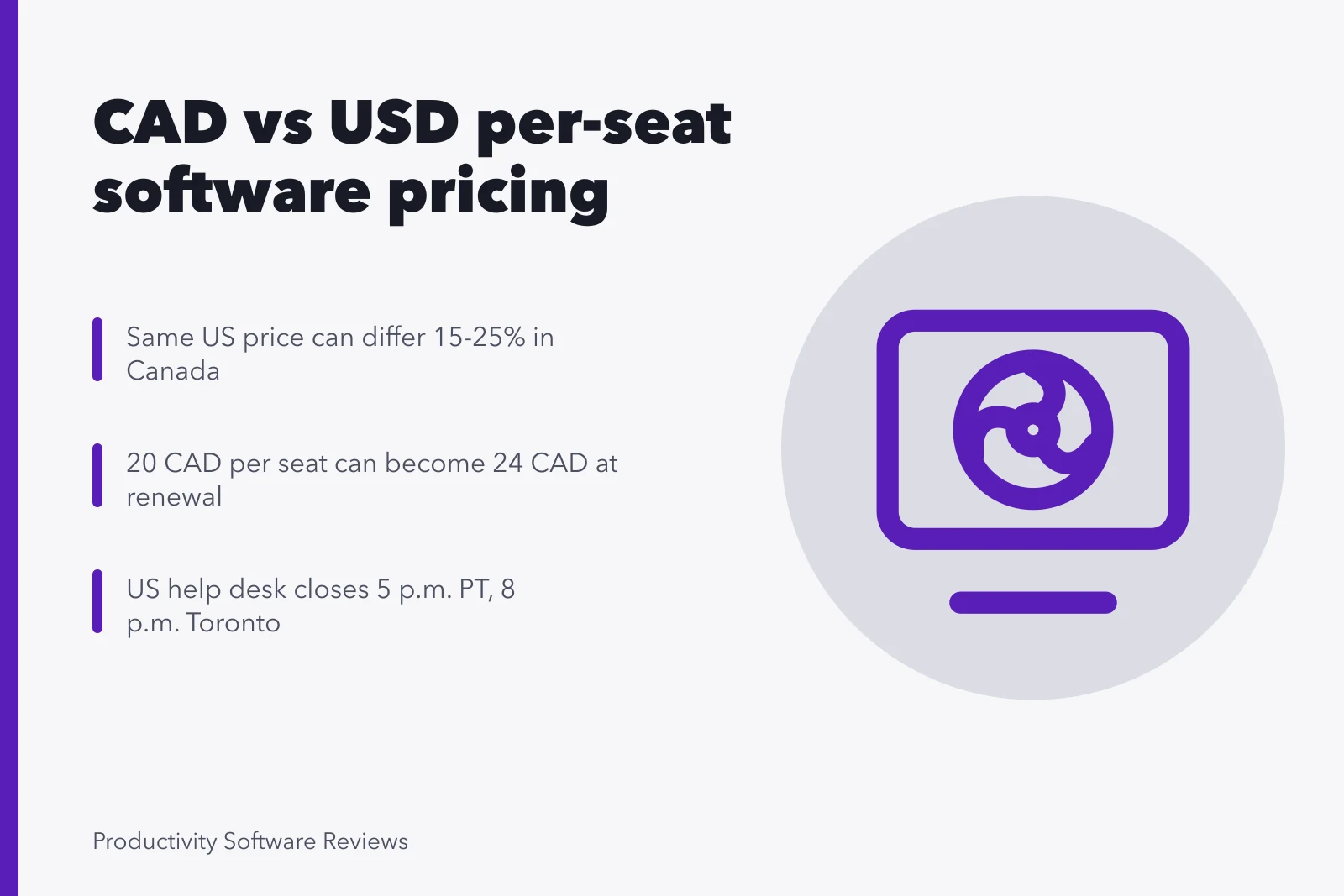
A US help desk on Pacific time closes at 5 p.m. PT, which is 8 p.m. in Toronto. It reopens at 8 a.m. PT, 11 a.m. in Ontario. Vendors with Canadian coverage build that cost into the seat price.
Checklist before you sign or renew
- Confirm the billing currency in the contract, not on the pricing page.
- Confirm whether the CAD rate is fixed for the term or reset at renewal.
- Confirm what counts as a seat. Assigned licences, shared mailboxes and seasonal staff are where quotes drift.
- Confirm whether the quote includes GST, HST, PST or QST.
- Budget a 10 percent cushion on any USD-billed contract.