Features
Part of Project management for people who want the details
Why should a first project management setup stay deliberately small?
Project management setup that survives: one board, few statuses with owners, controlled creation, and a first project that becomes the template on purpose.
The most common way a project tool fails is not that it was the wrong product. It is that somebody configured it thoroughly on day one, and by month four nobody could remember what half the fields were for.
Set up less than you think you need. The configuration you can defend in one sentence to a new joiner is the configuration that survives.
What to take away
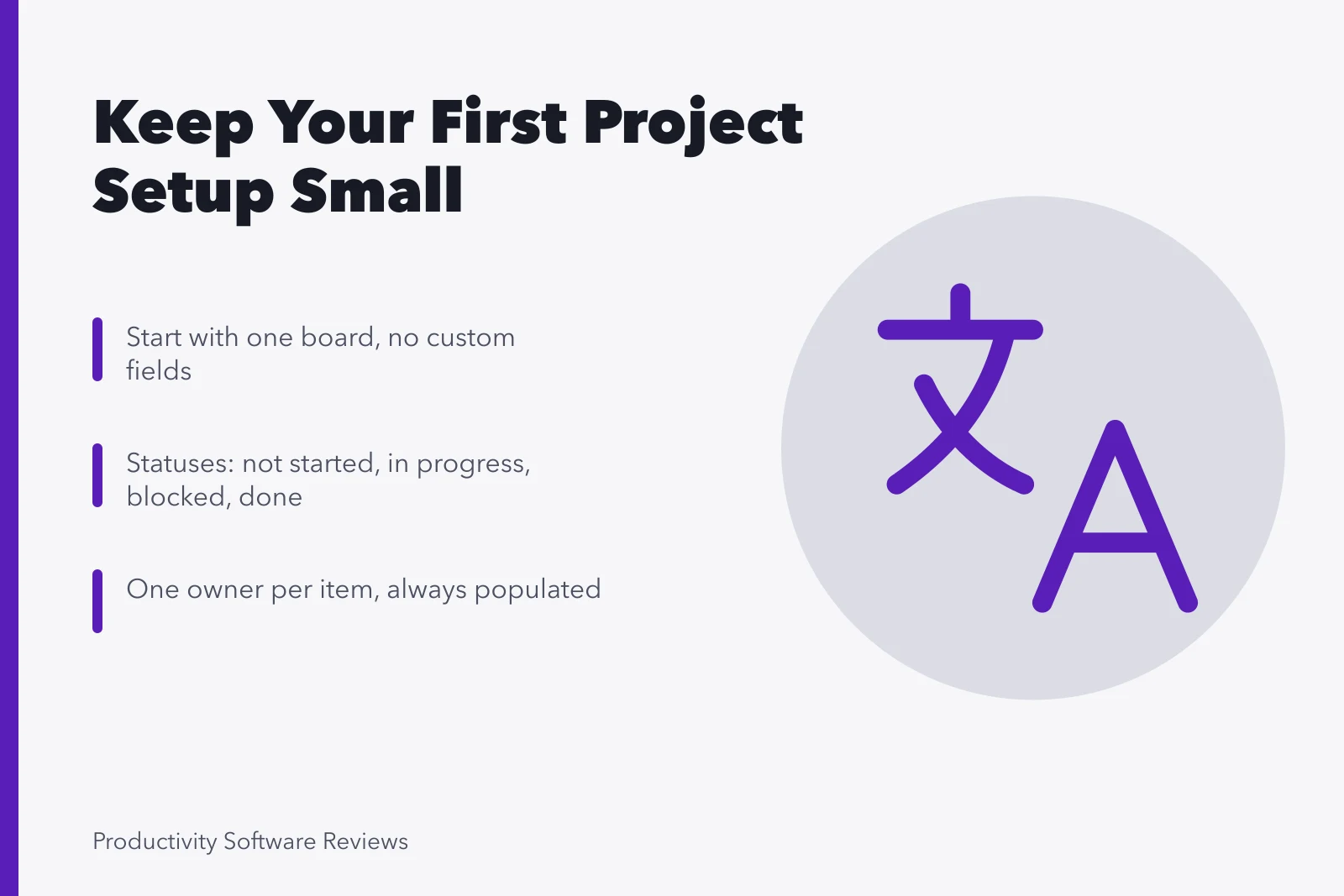
- Start with one board, one set of statuses, and no custom fields. Add only what a real difficulty forces you to add.
- Statuses are the contract. Each one must have a stated meaning and a person who moves work out of it.
- Decide who may create projects before anyone can. Uncontrolled creation is how you end up with forty boards and no view.
- Whatever you build in the first month becomes the template, whether you meant it to or not.
The smallest configuration that works
A first setup needs five decisions and nothing else.
Five First Decisions
Decision
- Statuses
- Not started, in progress, blocked, done
- Owner
- Exactly one person, always populated
- Due date
- Committed or estimate, labeled
- Priority
- Two levels, or none
- Custom fields
- None, at first
First Answer
- Statuses
- Extra statuses become queues
- Owner
- Two owners equals none
- Due date
- Mixed meanings break reports
- Priority
- Four levels collapse to two
- Custom fields
- Each field must be filled forever
Why Not More
- Statuses
- Owner
- Due date
- Priority
- Custom fields
A defensible first answer
- Statuses
- Not started, in progress, blocked, done
- Who owns an item
- Exactly one person, always populated
- What a due date means
- Committed, or an estimate, but pick one and label it
- Priority
- Two levels, or none
- Custom fields
- None, at first
Why not more
- Statuses
- Every extra status is a queue somebody has to empty
- Who owns an item
- Two owners is the same as none
- What a due date means
- Mixed meanings make every report untrustworthy
- Priority
- Four levels collapse to two within a quarter anyway
- Custom fields
- Each one is a field somebody has to fill in forever
The temptation is to model the whole process before anyone uses it. Resist. A configuration built from imagined needs encodes assumptions nobody has tested, and removing a field later is much harder than adding one, because by then reports depend on it.
Statuses are a contract, not labels
The single most useful hour of setup is spent writing one sentence for each status: what has to be true for an item to sit here, and who is responsible for moving it on.
Status Contract Rules
- Write one sentence per status
- Blockedsay by what, waiting on whom, who checks
- Done needs a stated definition
- Stale item after a month gets closed or rewritten
"Blocked" is the one that repays the effort. Blocked by what, waiting on whom, and who checks it. A blocked column with no owner becomes a place where work goes to be forgotten, and it is usually the biggest single source of surprise at the end of a project.
Two other rules worth setting from the start. An item cannot be marked done by the person who did the work without a stated definition of done, however light that definition is. And an item that has not moved in a month gets closed or rewritten, because a stale item is a lie about your capacity.
Decide who may create things
Uncontrolled project creation produces an estate nobody can report on. Uncontrolled field creation produces forms nobody completes. Both are easier to prevent than to unwind.
Who May Create What
Who may create work items?
anyone may create work items
restrict to a named group
A workable rule: anyone may create work items. A small named group may create projects, and only that group may change shared configuration. Attach a short intake step to project creation: what is this, who is accountable, when does it end.
This is not gatekeeping. A project with no end condition never closes. Half a dozen of those make every capacity view meaningless.
This is the same delegation question that runs through the administration console, and the answer should be consistent across your tools rather than invented separately in each.
The first project becomes the template
Whatever the first team does, everyone else copies. So run the first project deliberately, and pick one that is real, finite, and slightly awkward rather than an easy one.
First Project As Template
- Pick a real, finite, slightly awkward project
- Log every how-to question and field misuse
- Turn the log into a configuration backlog
- Write a one-page structure and field guide
- Make that page the start for new projects
While it runs, keep a plain log of every moment somebody asked how to do something, and every moment two people used the same field differently. That log is your configuration backlog, and it is worth more than any planning workshop, because it comes from use.
At the end, write a page: how this project was structured, what we would do differently, and what the fields mean. Then make that page the thing new projects start from. The category overview explains why the alternative, which is copying an existing board, propagates every mistake in it.
Plans, dependencies, and the honest limits
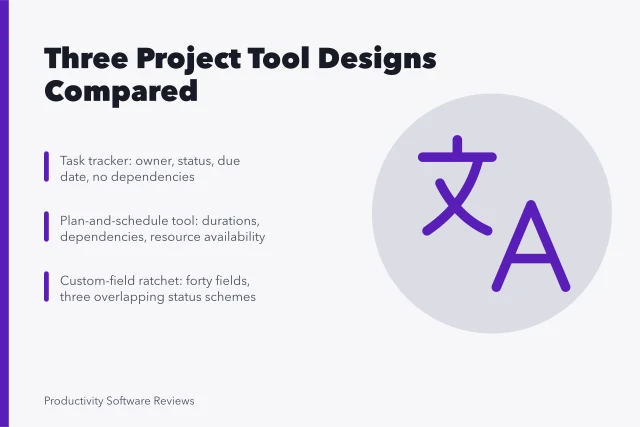
If your work involves genuine sequencing, meaning one task cannot start until another finishes, decide early whether you are going to model that or not. Half-modeled dependencies are worse than none, because the tool then produces dates that look authoritative and are not.
Model Dependencies Or Not
Do you have genuine sequencing?
model it fully and maintain it
use a simple ordered list with owners
The GAO Schedule Assessment Guide is unusually clear about what makes a schedule trustworthy. It lists the properties a schedule needs before anyone relies on its dates, including a duration for every activity and a complete sequence.
Read the guide as a description of what you are signing up to maintain. Then decide honestly whether you will.
For most teams the answer is that they will not, and a simple ordered list with a named owner per item is more truthful than a network diagram nobody updates.
Connect it to where the work already happens
A project tool that people have to remember to visit is a project tool people forget. Three connections are worth making in the first month, and no more.
Three First-Month Connections
- Notify team in their existing channel
- Link work items to their documents
- Give one shared cross-project view
Notify the team in the channel they already use, at a volume they tolerate, not the default level.
Link work items to the documents they refer to, so the current version is one click away, not attached in four places.
Give the people who need it one shared view of work across projects. Build it once, rather than each manager building their own.
Everything else can wait. Connections are cheap to add and expensive to maintain, and the register of what is wired to what belongs with your integration inventory from the beginning.
What to test before the rollout
Run these five checks with two accounts, one ordinary and one from outside, before anybody is told the tool is live. Permissions are easiest to reason about while the estate is small, which is the practical argument in the advice on securing cloud services: the settings are the same later, but the number of things they affect is not.
- Create an item as an ordinary member and confirm what they can and cannot change.
- Add an outside collaborator and check exactly what they can see across other projects.
- Close a project and confirm its items disappear from the views that should not include them.
- Remove a person from the team and check what happens to the items they owned.
- Export a project and open the result. If the export is unreadable, you have learned something important early.
Check five is the one people skip, and it is the one that matters if you ever move. The collaboration side of the estate and the storage conventions you already settled should line up with what you find.
Common questions
How long should the trial configuration run before we commit?
One complete project, however long that is for you. A fixed two week window ends before the interesting problems appear, which cluster around handover, blocked work, and closing things properly.
Should every team have the same configuration?
The statuses and the meaning of a due date, yes. Everything below that, no. Forcing one board shape onto teams with genuinely different work produces careful compliance and no useful data.
What about migrating existing work in?
Bring open items only, and rewrite them as you go. Importing three years of closed history gives you a searchable archive of things nobody will search and a configuration bent to fit the past.
Do we need custom fields at all?
Eventually, one or two. The test is whether a specific decision is currently being made from memory because the information is not recorded anywhere. That is a field. Everything else is a preference.