
Industry
How Seattle's email providers shape US deliverability rules
Email deliverability rules are shaped by Seattle email providers and cloud infrastructure, plus Google Postmaster Tools, Microsoft SNDS, DMARC, SPF and DKIM.
What to take away
- AWS runs Simple Email Service from Seattle, and Microsoft runs Exchange Online and Outlook.com from Redmond.
- Microsoft's Exchange Online rules for high-volume senders took effect on 5 May 2025 and cover senders of 5,000 or more messages a day.
- Google Postmaster Tools and Microsoft SNDS show how Gmail and Outlook judge your domain and your IPs.
- Gmail's complaint ceiling is 0.3%, with 0.1% as the working target, and SPF, DKIM and DMARC set the floor.
Seattle platforms and the rules they export
AWS runs Simple Email Service from Seattle. Microsoft runs Exchange Online and Outlook.com from Redmond. Both carry a large share of US commercial email. (24)
Comparing business email providers by turning each vendor claim into your own units beats reading a feature grid.
Requirements travel with the customers, because thousands of senders pass each provider rule down to their own clients and agencies.
Microsoft's requirements for high-volume senders took effect on 5 May 2025. Senders of 5,000 or more messages a day must have SPF or DKIM configured and a DMARC record published. Policy levels sit in Microsoft's DMARC configuration guide.
Google's bulk sender rules use the same 5,000-a-day line and add a complaint ceiling with one-click unsubscribe. The Gmail sender guidelines state what authenticated bulk mail must include.
Reputation dashboards: Postmaster Tools and SNDS
Both tools are free and both require proof of ownership. Postmaster Tools takes a DNS TXT record on the domain. SNDS takes registered IPs and a confirmed feedback address.
Google withholds data from low-volume domains, so some senders see blank charts. Domain reputation commonly appears once a domain sends several thousand messages a day to Gmail, a typical threshold rather than a published figure.
SNDS reports IP status, complaint volume and spam trap hits. Postmaster Tools reports spam rate, IP reputation and domain reputation.
Reputation dashboards
Google Postmaster Tools
- Spam complaint rate
- Yes
- IP reputation
- Yes
- Domain reputation
- Yes
- Feedback loop data
- Yes
- Spam trap hits
- No
Microsoft SNDS
- Spam complaint rate
- Yes
- IP reputation
- Yes, as status
- Domain reputation
- No
- Feedback loop data
- No
- Spam trap hits
- Yes
Google asks bulk senders to hold spam complaints under 0.1% and warns that sustained rates near 0.3% put delivery at risk. Check both dashboards weekly.
Setup steps sit in Google's Postmaster Tools documentation. US deliverability tools: Google Postmaster Tools and Microsoft SNDS explains what each weak signal means.
Authentication order: SPF, DKIM, DMARC
Mailbox providers and Seattle platforms push the same three standards. Implement them in this order, because DMARC cannot pass while the other two are missing.
Authentication order
- Publish one SPF record listing every legitimate sending source, including your cloud provider.
- Keep SPF inside the ten DNS lookup limit in RFC 7208, or the check fails outright.
- Generate a DKIM key pair, publish the public key in DNS, and sign mail at the platform.
- Send to an outside mailbox and confirm the signature verifies.
- Publish DMARC at p=none with an rua address, then collect reports for two to four weeks.
- Move to p=quarantine, then p=reject, once alignment passes daily.
Alignment is where senders slip. DMARC passes when SPF or DKIM matches the From domain, so compare the DKIM d= value and the SPF envelope domain against the header domain.
Shared IP pools and the reputation you inherit
Cloud sending means sharing an IP pool with strangers. A spam trap hit anywhere in the pool can lower delivery for every sender drawing from it.
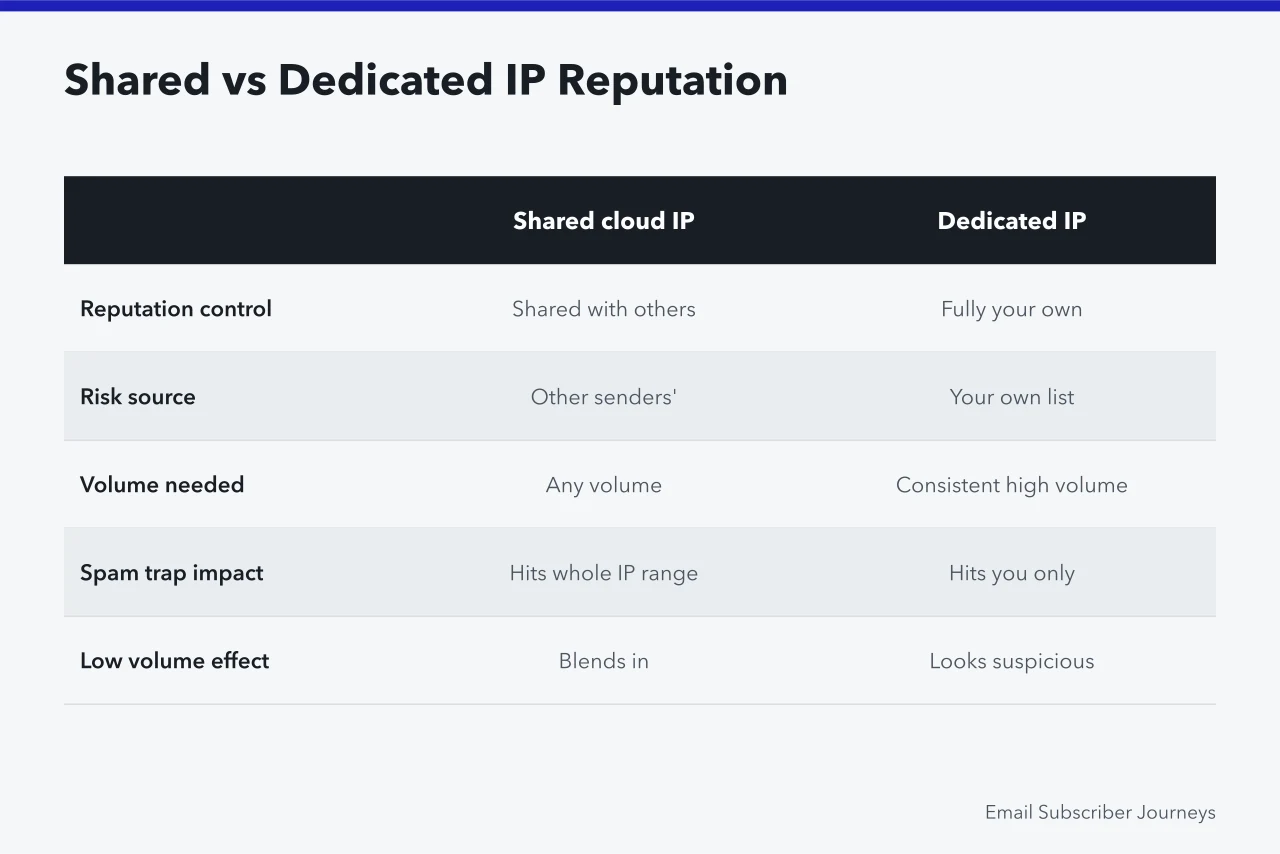
Dedicated IPs need volume to work. Typical vendor guidance puts the floor in the tens of thousands of messages a month, because a quiet IP looks suspicious.
Ask which pool carries your mail before you sign, and what notice you get when it changes. For Canadian subscribers, how to check Canadian data residency claims from email vendors separates a real Canadian region from a marketing line.
What US law adds
CAN-SPAM sets the federal floor and the FTC enforces it. Accurate headers, a working opt-out honored within 10 business days, and a postal address in every message. Penalties are charged per email and adjusted for inflation each year.
Washington adds the Commercial Electronic Mail Act (RCW 19.190), which gives recipients a private right of action against misleading commercial mail.
Steps for senders outside Seattle
The work is the same wherever you send. Run this list quarterly and fix the first item that fails.
- One SPF record covering every sender, under ten lookups.
- DKIM signing live, with a key rotation date on the calendar.
- DMARC at p=none, then stricter, with reports reviewed.
- Postmaster Tools and SNDS registered for every sending domain.
- Complaint rate checked weekly and held under 0.1%.
- IP pool named in the vendor contract.
Dedicated IPs and strict DMARC enforcement cost money, and a list of a few thousand subscribers rarely justifies either. Track inbox placement by mailbox provider instead of one blended number.
Canadian senders owe records as well as authentication. The five records Canadian email teams must log under CASL lists what to keep, and for how long.