Rules
PIPEDA, Ontario, BC and Alberta privacy rules for software buyers
Productivity software reviews must match PIPEDA, Ontario, BC PIPA, and Alberta PIPA duties, so know the vendor contract terms each regime forces.
What to take away
- Productivity software reviews often skip the legal test, so map every vendor against PIPEDA and the provincial statutes before you shortlist.
- PIPEDA sets the floor for federally regulated and cross-border work, while Ontario, British Columbia, and Alberta add their own rules for health, public bodies, and provincially regulated employers.
- The four regimes diverge most on consent, breach notification, and access requests, which changes the clauses you need in the contract.
- Each regime forces specific vendor contract termsbreach notice windows, audit rights, data location limits, retention schedules, and deletion proof.
- A privacy impact assessment is the fastest way to expose gaps that a feature comparison will never show.
PIPEDA as the federal floor for software buyers
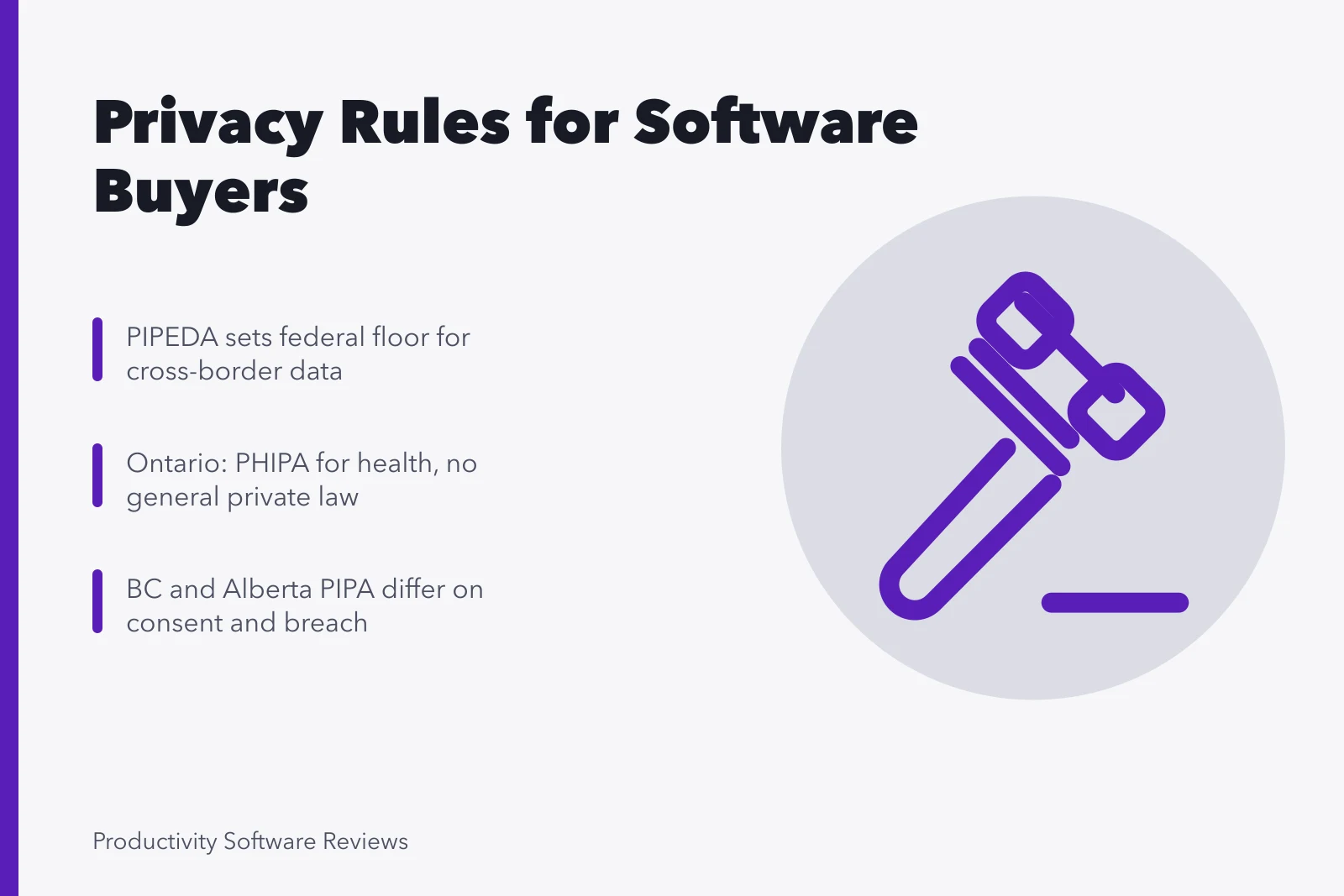
PIPEDA applies to private-sector organizations that collect, use, or disclose personal information in the course of commercial activity. It also covers federally regulated sectors such as banking, telecom, air, rail, and marine shipping. For a software buyer, that means the federal statute sets the baseline whenever a vendor handles employee or customer data across provincial lines.
The Office of the Privacy Commissioner of Canada oversees PIPEDA and publishes business guidance on consent that shapes what a buyer can demand. That guidance covers safeguards and accountability too, which are the areas where vendor answers tend to be thinnest. Read it before you write your requirements list.
The statute itself sits on the federal Justice Laws Website, which is where you go for exact wording rather than a vendor summary. Ten principles sit under PIPEDA, and the vendor contract should map to each one. If a vendor cannot say who its privacy officer is, accountability is already broken.
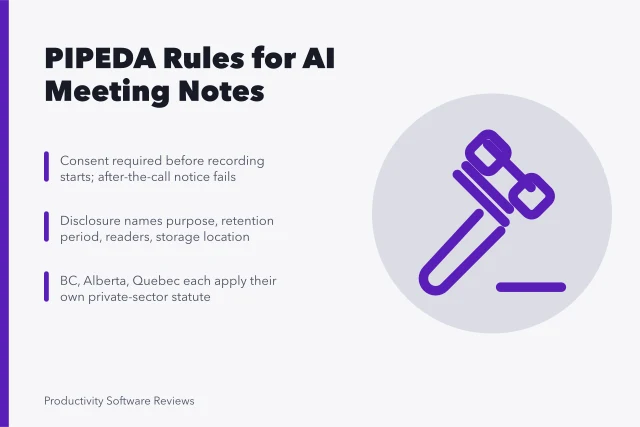
Consent under PIPEDA must be meaningful and tied to a stated purpose. Blanket consent buried in a services agreement is weak. For software that ingests email, chat, or meeting content, the purpose must be narrow enough that an employee can understand what happens to their words.
Buyers weighing transcription tools should read the consent and retention problems set out in consent under PIPEDA for AI meeting notes.
Breach duties under PIPEDA sit in section 10.1 and the Breach of Security Safeguards Regulations. A vendor must report a breach to the OPC as soon as feasible after it determines that a breach occurred. It must tell affected individuals as soon as feasible when the breach creates a real risk of significant harm to them.
Records of every breach, reported or not, must be kept for 24 months. A buyer should ask how the vendor decides on risk, who signs off, and how quickly it tells you.
Access requests are the quiet test of any platform. PIPEDA gives individuals the right to see their personal information and to challenge its accuracy, and the organization must answer within 30 days. If your vendor cannot produce a person's data in a usable format, you will absorb that failure. Ask for a documented access workflow before you sign.
The Office of the Privacy Commissioner of Canada publishes a privacy laws in Canada overview that buyers can use to map the regimes. Build a one-page matrix from it before any vendor conversation.
Ontario's public-sector and health privacy regimes
Ontario does not have a general private-sector privacy statute in the way British Columbia and Alberta do. Instead, it has a set of sector statutes that matter enormously to software buyers in health care, education, and the broader public sector. The Office of the Information and Privacy Commissioner of Ontario oversees them.
The Personal Health Information Protection Act governs health information custodians and their agents. If your software touches patient records, the vendor is likely an agent or a service provider with specific duties. That status carries rules on collection, use, disclosure, and retention that go beyond PIPEDA.
For provincial ministries and broader public-sector bodies, the Freedom of Information and Protection of Privacy Act applies. Municipal institutions fall under a separate municipal freedom of information statute. Software sold into these bodies must support access requests, records retention, and disclosure logging.
Cite the exact provisions from the Ontario e-Laws statute page when your legal team needs the reference and not a paraphrase.
Ontario's health regime also has a strong audit and logging expectation. Custodians must be able to show who viewed a record and when, and retention, redaction, and audit logs are how that is demonstrated.
PHIPA adds a breach notice duty of its own. The custodian must tell affected individuals at the first reasonable opportunity when their health information is lost, stolen, or used or disclosed without authority. Notice to the IPC is required in the circumstances set out in the regulation.
Procurement in Ontario often adds a privacy impact assessment before a contract is signed. The assessment asks what personal information flows into the tool, where it sits, who can see it, and how it is destroyed. Run it early, because the answers change the shortlist.
British Columbia's PIPA and provincial oversight
The Personal Information Protection Act in British Columbia governs private-sector organizations in the province. It applies to provincially regulated employers, which covers most businesses in the province. The Office of the Information and Privacy Commissioner for British Columbia oversees it.
BC PIPA requires consent for collection, use, and disclosure, with limited exceptions. It also requires organizations to designate a privacy officer and to develop policies and practices. A software vendor selling into BC should be able to name that person and produce the policy on request.
BC PIPA has a breach notification duty that predates the federal rule. An organization must notify the commissioner and affected individuals without unreasonable delay after it determines that a breach occurred and there is a real risk of significant harm. The commissioner can also order an organization to notify.
Access requests run on a 30 business day clock in BC. An organization must respond within that window and may extend it by up to 30 more business days if it tells the individual why. A reasonable fee is permitted, with an estimate before the work starts. A refusal has to state the reason in writing.
The same clock covers a request to correct inaccurate information. If the organization will not correct the record, it must tell the individual why and how to bring the matter to the commissioner.
BC's public bodies operate under a separate statute, the Freedom of Information and Protection of Privacy Act. Software sold to provincial ministries, health authorities, and school districts must support access requests and records schedules. The province publishes data and information management guidance that sets expectations for how information is stored, shared, and disposed of.
Data residency is a recurring theme in BC procurement. Public bodies often ask where data is stored and who can access it from outside Canada. A vendor that cannot answer precisely will be scored down, even if the feature set is strong.
Alberta's PIPA and the OIPC Alberta role
Alberta's Personal Information Protection Act covers provincially regulated private-sector organizations. The Office of the Information and Privacy Commissioner of Alberta oversees it. The statute is broadly similar to BC PIPA, but the details differ enough that a single contract template will not satisfy both.
Alberta PIPA requires consent, but it also recognizes implied consent in some circumstances and allows for reasonable collection without consent in narrow cases. That flexibility is not a licence to skip notice. Organizations still need clear purposes and safeguards.
Alberta's breach rule uses the same harm threshold as BC and PIPEDA, and notice goes to the Alberta commissioner and to affected individuals without unreasonable delay. The commissioner can require notification after an investigation. Vendors must be able to support that timeline with logs and contact data.
Alberta's commissioner has been active on access and correction requests. An organization has 45 days to answer an access request, counted from the day it receives it. It may extend that period if it tells the individual why.
Fees are allowed, and the individual should get an estimate before the work starts. A request to correct inaccurate information must be answered with a correction or with the individual's own statement attached to the record. A software platform that cannot track correction requests will create work for your privacy office.
Alberta's health information statute, the Health Information Act, applies separately to custodians. If your software touches health data in Alberta, you may face both PIPA and the Health Information Act. The vendor contract should say which regime applies and who is the custodian.
Where breach notice, access and penalties differ
Consent is the first divergence. PIPEDA requires meaningful consent with a knowledge and consent standard. BC PIPA and Alberta PIPA also require consent but define exceptions differently. Ontario's health and public-sector statutes use different consent models, including express consent for many health disclosures.
Consent and breach duties by regime
PIPEDA
- Consent model
- Meaningful consent
- Breach notice to
- OPC and individuals
- Access and correction
- Right of access
- Oversight body
- OPC
BC PIPA
- Consent model
- Consent with exceptions
- Breach notice to
- Commissioner and individuals
- Access and correction
- Own timelines and fees
- Oversight body
- BC OIPC
Alberta PIPA
- Consent model
- Implied consent allowed
- Breach notice to
- Commissioner and individuals
- Access and correction
- Own timelines and fees
- Oversight body
- Alberta OIPC
Ontario
- Consent model
- Express for health
- Breach notice to
- Sector regulator
- Access and correction
- Public bodies and custodians
- Oversight body
- Ontario IPC
Breach notification is the second divergence. All four regimes aim at harm, but each runs on its own clock. PIPEDA asks for notice as soon as feasible, and BC PIPA and Alberta PIPA ask for it without unreasonable delay.
PHIPA asks for notice to the individual at the first reasonable opportunity. Each regime reports to its own commissioner. A breach that touches customers in all three provinces can trigger three notifications.
Access and correction rights differ in procedure. PIPEDA gives individuals a right of access and 30 days for a response. BC PIPA allows 30 business days with an extension, and Alberta PIPA allows 45 days.
BC PIPA and Alberta PIPA allow a reasonable fee for access, with an estimate before the work starts. Ontario's statutes give access rights to records held by public bodies and health custodians, with exemptions that do not exist federally.
Oversight differs. The OPC handles PIPEDA complaints and can take matters to Federal Court. BC's and Alberta's commissioners can issue orders that are enforceable in their provinces. Ontario's commissioner oversees a more fragmented set of statutes. Your vendor's compliance story must name the right regulator for each customer group.
Enforcement powers differ as well. The OPC can enter compliance agreements, and PIPEDA offences carry a maximum fine of $100,000 on summary conviction. BC's and Alberta's commissioners issue orders that bind organizations in their provinces.
Ontario's commissioner issues orders under PHIPA and the freedom of information statutes. A vendor cannot claim a single national compliance posture without evidence, and the security defaults behind that claim are worth their own review in office suites security.
Main scope
- PIPEDA
- Federally regulated and cross-border commercial activity
- Ontario
- Health custodians and public bodies
- British Columbia PIPA
- Provincially regulated private-sector organizations
- Alberta PIPA
- Provincially regulated private-sector organizations
Regulator
- PIPEDA
- Office of the Privacy Commissioner of Canada
- Ontario
- Office of the Information and Privacy Commissioner of Ontario
- British Columbia PIPA
- Office of the Information and Privacy Commissioner for British Columbia
- Alberta PIPA
- Office of the Information and Privacy Commissioner of Alberta
Breach duty
- PIPEDA
- Report to OPC as soon as feasible; notice to individuals on real risk of significant harm; breach records kept 24 months
- Ontario
- PHIPA notice to individuals at the first reasonable opportunity; IPC notice in prescribed cases
- British Columbia PIPA
- Notice to commissioner and individuals without unreasonable delay
- Alberta PIPA
- Notice to commissioner and individuals without unreasonable delay
Consent model
- PIPEDA
- Knowledge and consent
- Ontario
- Express consent in many health contexts
- British Columbia PIPA
- Consent with limited exceptions
- Alberta PIPA
- Consent, including implied in some cases
Contract terms each regime forces into a vendor agreement
Every regime pushes a core set of vendor contract terms into the agreement. The wording changes, but the buyer's demands do not. Seven clauses do the work.
Contract terms each regime forces
- Breach notice, with a fixed window and a named contact.
- Audit and access logs you can export, listed as a deliverable.
- Data location, including limits on access from outside Canada.
- Retention periods matched to your own records schedule.
- Deletion on exit, with proof.
- Subprocessor list, change notice and a right to object.
- A named privacy officer and a duty to cooperate with access and correction requests.
Vendor contract terms to demand
- Define personal information and permitted purposes
- Set a fixed breach notification window
- Require privacy impact assessment before go-live
- Grant audit rights over logs and subprocessors
- Limit data location and cross-border transfers
- Set retention and deletion schedules with proof
- Require access and correction support
A worked example shows how this plays out. Suppose a Toronto hospital network buys a scheduling tool that stores employee and patient-adjacent data. PIPEDA may apply to some flows, Ontario's health statute applies to the patient-adjacent data, and the vendor is likely an agent.
The contract needs a breach window, audit rights, Ontario storage or strict transfer terms, retention aligned to hospital records schedules, and access support for patient requests. A feature comparison would never surface those clauses.
If the same tool is sold to a BC health authority, BC PIPA and the provincial freedom of information statute come into play. The buyer will ask where data sits and who can see it.
If it is sold to an Alberta clinic, Alberta PIPA and the Health Information Act may both apply. One contract template will not cover all three.
A vendor that cannot show encryption, access controls, and logging will struggle to meet the safeguards principle in any regime. The same logic applies to team collaboration security, because chat and file tools widen the data surface faster than privacy teams can review it.
No Canadian statute sets a fixed hour count for breach notice, so the contract window is where you create certainty. A typical buyer demand is notice within 24 hours of a confirmed breach and within 72 hours of a suspected one, with a written report inside five business days.
Sample breach clause: "The vendor will notify the customer within 24 hours of determining that a breach of security safeguards involving customer personal information has occurred, and will provide a written report within five business days."
Sample subprocessor clause: "The vendor will publish a current list of subprocessors, give the customer 30 days notice before a subprocessor begins processing customer personal information, and allow the customer to object."
Subprocessors are a common blind spot. A vendor that refuses to publish its list is telling you something about its compliance maturity.
Training and AI features need explicit terms. If the vendor uses customer data to improve models, that is a use for a new purpose. Consent must cover it, or the vendor must offer an opt-out. Ask for the default setting and the contract language that locks it.
Termination and data return are the last test. The contract should say what happens to your data on exit, in what format it is returned, and how deletion is proven. Without that, your retention schedule is a promise you cannot keep.
How to check a productivity software review for privacy evidence
Most productivity software reviews compare features, pricing, and integrations. Few ask which privacy regime applies to your organization. That gap is where procurement mistakes happen, because a tool that passes a federal review may fail an Ontario health review or a BC public-body review.
Start every review with a jurisdiction question. Is your organization federally regulated, provincially regulated, a health custodian, or a public body? The answer decides whether PIPEDA, Ontario's statutes, BC PIPA, or Alberta PIPA leads. It also decides which commissioner can receive a complaint.
Then check the review for evidence, not adjectives. A useful review names the regulator, the breach timeline, the data location options, and the access workflow. If it does not, treat the compliance section as marketing.
Ask the vendor to prove who had access when an auditor or a complainant asks. If the platform cannot show who had access and since when, the buyer carries that risk alone, and the same access evidence is what time tracking software canadian overtime rules depend on when payroll records are audited.
Ask vendors for their privacy impact assessment template and a recent example. A vendor that has done this before will have one ready. A vendor that has not will send a security whitepaper instead.
A usable template names the data elements collected, the purpose of each use, the legal basis, the retention period, where the data is stored, who can reach it, and how it is deleted. It also carries a risk section with mitigations and a named owner.
Finally, read the contract before the demo. The clauses that matter are rarely visible in a trial. Breach notice, audit rights, data location, retention, and deletion proof separate a tool you can defend from a file you cannot close.